7 Powerful Ways to Score Full A+ in 10th English Medium SSLC
Many Class 10 students dream of achieving excellent grades in every subject, but strong results require more than studying for long hours. Understanding How to Score Full A+ in 10th English Medium SSLC begins with creating a practical plan, learning each concept clearly, revising regularly, and practising answers under examination conditions.
A Full A+ result is usually built through consistent daily effort rather than last-minute preparation. Students should identify their strong and weak subjects, complete the syllabus systematically, solve previous question papers, and correct mistakes before the final examination.
What Does Full A+ Mean in SSLC?
A Full A+ result means achieving the highest grade across all SSLC subjects. It reflects consistent performance in languages, Mathematics, Science, Social Science, and other subjects included in the student’s programme.
Students aiming for this result must prepare equally for every paper. Scoring well in preferred subjects alone is not enough. Even one neglected subject can affect the overall grade profile.
Learning How to Score Full A+ in 10th English Medium SSLC therefore involves:
- Completing every subject on time
- Understanding the official syllabus
- Revising chapters repeatedly
- Practising textbook-based questions
- Improving handwriting and presentation
- Solving previous question papers
- Attending model examinations
- Correcting repeated errors
- Managing examination time
- Maintaining healthy study habits
The goal should not be perfection from the first day. Students should focus on gradual and measurable improvement.
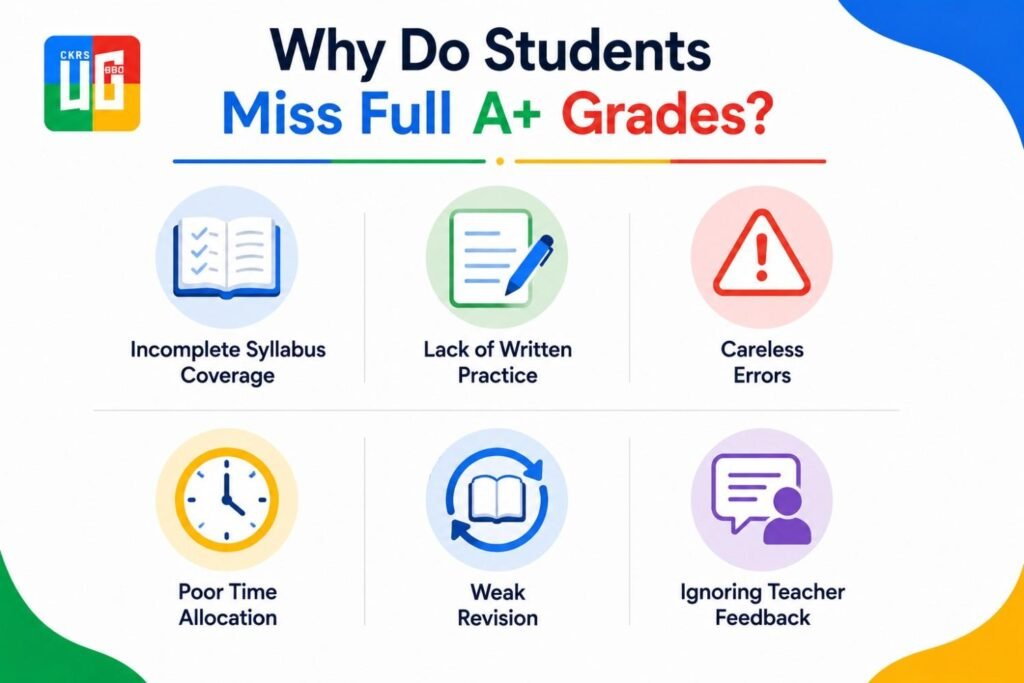
Why Do Students Miss Full A+ Grades?
Many capable students lose marks because of avoidable preparation and examination mistakes.
Incomplete Syllabus Coverage
Some students spend too much time studying favourite subjects and postpone difficult chapters. This creates gaps during final revision.
Lack of Written Practice
Reading textbook answers may feel easy, but students sometimes struggle to reproduce the same information during an examination.
Careless Errors
Small mistakes in question numbers, calculations, spelling, units, diagrams, or grammar can reduce marks.
Poor Time Allocation
A student may spend too much time on early questions and rush through the final section of the paper.
Weak Revision
Lessons that are understood once may be forgotten if they are not revised regularly.
Ignoring Teacher Feedback
Repeated errors continue when students do not review corrected notebooks, tests, and assignments.
Understanding these difficulties is an important part of learning How to Score Full A+ in 10th English Medium SSLC.
7 Powerful Ways to Score Full A+ in 10th English Medium SSLC
1. Build a Complete Subject-Wise Study Plan
The first step is to list every subject and chapter in the syllabus.
Create four categories:
- Strong and fully revised
- Understood but needs practice
- Partially understood
- Not yet completed
This classification makes preparation more focused. Students should begin working on unfinished and weak chapters while continuing short revisions of stronger areas.
A weekly plan may include:
- Mathematics practice every day
- Science revision on alternate days
- Language writing exercises
- Social Science answer preparation
- One weekly model test
- One session for correcting mistakes
- One cumulative revision period
A good timetable should be realistic. It should include school hours, tuition classes, homework, meals, sleep, and short breaks.
2. Master the Textbook Before Using Extra Materials
The official textbook should remain the main study resource. Guidebooks and online notes can support preparation, but they should not replace textbook learning.
Students should carefully study:
- Lesson explanations
- Definitions
- Examples
- Activities
- Diagrams
- Tables
- Exercises
- Summary points
- In-text questions
- Review questions
Textbook familiarity helps students recognise how concepts are presented and how questions may be framed.
To understand How to Score Full A+ in 10th English Medium SSLC, students should learn the textbook content thoroughly before moving to additional question banks.
3. Use Active Recall Instead of Passive Reading
Passive reading means repeatedly looking at the same page without testing memory. Active recall requires students to close the book and retrieve information independently.
After studying a topic, try to:
- Explain it aloud without looking
- Write the main points from memory
- Answer five short questions
- Draw the relevant diagram
- Recall formulas or dates
- Teach the concept to someone else
- Create a quick summary
Active recall reveals whether the lesson has actually been learned.
Students can also use flashcards for:
- Mathematical formulas
- Scientific definitions
- Chemical equations
- Historical dates
- Geography terms
- Grammar rules
- Vocabulary
- Important names and events
This method makes revision more effective and less dependent on repeated reading.
4. Follow a Planned Revision Cycle
A chapter should be revised several times before the final examination.
A simple revision cycle can be:
- First revision on the same day
- Second revision after three days
- Third revision after one week
- Fourth revision after one month
- Final revision before the examination
Each revision does not need to be lengthy. Students can use short notes, question cards, formulas, diagrams, timelines, and summary tables.
Regular revision is one of the most important answers to How to Score Full A+ in 10th English Medium SSLC, because it improves long-term memory and reduces last-minute pressure.
5. Practise Writing High-Scoring Answers
Knowing the content is important, but students must also present it clearly.
A strong answer should:
- Match the exact question
- Include relevant keywords
- Follow the required format
- Use complete sentences
- Be organised into points where suitable
- Include labelled diagrams when required
- Show every calculation step
- Avoid unnecessary information
- Maintain readable handwriting
- Use correct spelling and grammar
For long answers, students can follow this structure:
- Begin with a direct introductory sentence.
- Present the main points in logical order.
- Add examples, explanations, or diagrams when needed.
- End with a clear concluding statement.
Practise answers according to the marks allotted. A one-mark answer should be brief, while a higher-mark response requires more explanation.
6. Solve Previous Papers and Model Examinations
Previous question papers help students understand the examination pattern and identify common question formats.
They reveal:
- Mark distribution
- Frequently tested concepts
- Expected answer length
- Difficulty level
- Time required for each section
- Types of application-based questions
- Areas that require repeated revision
Students should initially solve questions chapter by chapter. After completing the syllabus, they should attempt full papers under timed conditions.
During a model examination:
- Sit in a quiet place
- Follow the official duration
- Avoid textbooks and notes
- Write all answers fully
- Keep time for checking
- Correct the paper afterwards
Maintain a model-exam record containing:
- Total score
- Unanswered questions
- Careless mistakes
- Weak chapters
- Time-management problems
- Presentation issues
- Topics to revise again
This transforms every model examination into a practical improvement tool.
7. Review Mistakes Until They Disappear
Students often focus only on marks and ignore the reason behind lost marks. However, detailed error correction is essential for Full A+ preparation.
Create an error notebook with sections for:
- Conceptual mistakes
- Calculation errors
- Spelling mistakes
- Grammar errors
- Missing keywords
- Incomplete answers
- Incorrect diagrams
- Wrong question numbers
- Time-management problems
For every error:
- Write the original question.
- Identify why the answer was wrong.
- Write the correct method.
- Attempt a similar question.
- Review it again after a few days.
This process prevents the same mistake from appearing in the final examination.
Subject-Wise Full A+ Preparation Strategy
Mathematics
Mathematics requires regular practice rather than occasional long study sessions.
Students should:
- Learn every formula with meaning
- Practise textbook exercises
- Show calculation steps clearly
- Review incorrect problems
- Practise geometry construction
- Check units and signs
- Solve mixed chapter questions
- Attempt timed worksheets
Do not memorise answers to numerical problems. Understand the method so it can be applied to unfamiliar questions.
A separate formula notebook can support quick revision.
Physics
Physics includes concepts, laws, formulas, units, diagrams, and numerical questions.
For stronger preparation:
- Understand each scientific principle
- Learn symbols and SI units
- Practise numerical problems
- Draw clean labelled diagrams
- Review experiments and observations
- Connect concepts with real-life examples
- Write formulas before substitution
- Check the final unit
Students should learn when a formula is used instead of memorising it without context.
Chemistry
Chemistry preparation should include equations, reactions, properties, scientific terms, and applications.
Students can:
- Practise balancing equations
- Learn symbols and valencies
- Prepare reaction charts
- Compare substances using tables
- Review experimental observations
- Learn conditions required for reactions
- Write chemical names correctly
- Revise textbook activities
Chemical equations should be written repeatedly until students can recall them accurately.
Biology
Biology requires clear understanding and organised recall.
Students should focus on:
- Scientific terminology
- Body processes
- Functions
- Cause-and-effect relationships
- Diagrams
- Comparisons
- Sequences
- Environmental concepts
Flowcharts are useful for complex processes. Labelled diagram practice is equally important because even familiar diagrams can be difficult to reproduce without writing practice.
Social Science
Social Science preparation should not depend on memorising large paragraphs.
Students can use:
- Historical timelines
- Cause-and-effect tables
- Geography maps
- Comparison charts
- Keyword lists
- Short chapter summaries
- Economic examples
- Civics concept notes
Answers should be written with headings and clear points. Dates, names, places, and key terms must be checked carefully.
English
English requires continuous reading and writing practice.
Students should prepare:
- Prose lessons
- Poetry
- Character analysis
- Themes
- Vocabulary
- Grammar
- Comprehension
- Letter writing
- Diary entries
- Reports
- Notices
- Essays
Answers should be written in complete, grammatically correct sentences. Students should understand the lesson rather than memorising one fixed answer.
Malayalam, Hindi
Language subjects require attention to content, grammar, spelling, and writing formats.
Preparation may include:
- Reading lessons aloud
- Learning meanings
- Practising grammar
- Writing summaries
- Preparing character sketches
- Reviewing poems
- Practising letters and essays
- Correcting spelling errors
- Solving comprehension exercises
Students should practise handwriting regularly to improve speed and clarity.
Common Mistakes That Reduce A+ Chances
Students should avoid:
- Depending on last-minute study
- Ignoring one subject
- Studying only important questions
- Memorising without understanding
- Skipping textbook exercises
- Avoiding writing practice
- Neglecting diagrams and maps
- Writing beyond the question
- Leaving model papers uncorrected
- Sleeping too little
- Comparing constantly with classmates
- Studying with frequent mobile distractions
A Full A+ goal becomes more realistic when these habits are corrected early.
Healthy Habits for Better Academic Performance
Good health supports memory and concentration.
Students should:
- Sleep adequately
- Eat regular balanced meals
- Drink enough water
- Take short movement breaks
- Avoid excessive late-night study
- Reduce unnecessary screen use
- Spend a few minutes outdoors
- Discuss stress with a trusted adult
A tired student may spend many hours studying without retaining much information. Rest should therefore be included in the preparation plan.
Conclusion
Understanding How to Score Full A+ in 10th English Medium SSLC requires a combination of concept learning, organised revision, writing practice, model examinations, and careful error correction. Students should give balanced attention to every subject and avoid depending on last-minute preparation.
A Full A+ result cannot be guaranteed by one technique, but a disciplined daily routine can improve the chances of achieving strong grades. With textbook-based learning, active recall, timed practice, healthy habits, and consistent teacher guidance, students can enter the SSLC examinations with greater confidence and clarity.
Students can also access official Kerala State Board textbooks and learning resources through SCERT Kerala .