
9 Powerful Best Study Plan for 10th English Medium Students!
Class 10 is an important academic stage that requires consistency, clear goals, and proper time management. The Best Study Plan for 10th English Medium Students helps learners complete the syllabus, revise every subject, practise previous questions, and prepare confidently for the SSLC examination. For students following the state syllabus in Kerala, an organised routine can make daily learning easier and reduce last-minute pressure.
Studying for many hours without direction may not produce good results. Students need a balanced plan that gives enough time to Mathematics, Science, Social Science, English, Malayalam, Hindi, and other subjects.
A useful plan must also include schoolwork, tuition, revision, mock tests, rest, exercise, and sleep. This guide explains how students can develop a practical schedule that supports better understanding and steady academic improvement.
What Is the Best Study Plan for 10th English Medium Students?
The Best Study Plan for 10th English Medium Students is a structured learning schedule created around the student’s subjects, school timetable, strengths, weaknesses, examination dates, and personal learning speed.
It does not simply tell students how many hours to study. It explains:
- What subject to study
- Which chapter to complete
- How much time to allocate
- When to revise the lesson
- When to practise questions
- How to measure improvement
- When to take breaks
- How to prepare for model examinations
A good SSLC study schedule divides large academic goals into small daily tasks. Instead of planning to “finish Science,” the student may plan to revise one Physics chapter, answer five Chemistry questions, and draw two Biology diagrams.
This makes the study goal clear, achievable, and easy to monitor.
Why Class 10 Students Need a Structured Study Plan
Students often have several responsibilities during the academic year. They must attend school, complete assignments, participate in tuition classes, revise lessons, prepare projects, and write examinations.
Without a schedule, students may spend too much time on comfortable subjects while avoiding difficult ones. They may also postpone revision until the examination is close.
The Best Study Plan for 10th English Medium Students creates a healthy learning routine. It allows students to cover every subject without feeling that the entire syllabus must be completed at once.
A structured plan can help students:
- Complete chapters on time
- Revise lessons regularly
- Identify weak areas early
- Improve answer-writing speed
- Reduce examination stress
- Maintain consistent academic progress
- Balance learning and relaxation
- Avoid last-minute preparation
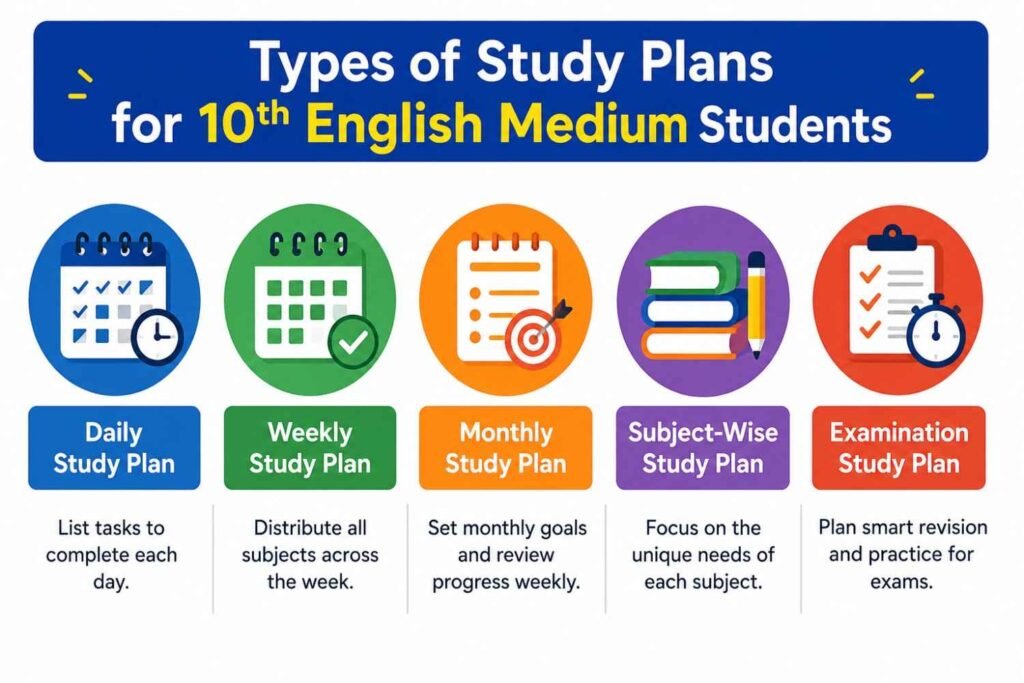
Types of Study Plans for 10th English Medium Students
There is no single timetable suitable for every learner. The Best Study Plan for 10th English Medium Students can be adapted according to individual needs.
Daily Study Plan
A daily plan lists the tasks that must be completed before the day ends.
A simple weekday schedule may include:
- 30 minutes for schoolwork
- 45 minutes for Mathematics
- 45 minutes for Science
- 30 minutes for language study
- 30 minutes for revision
- 15 minutes for planning the next day
The exact schedule can be changed according to school and tuition timings.
Weekly Study Plan
A weekly plan helps students distribute all subjects across seven days.
For example:
- Monday: Mathematics and English
- Tuesday: Physics and Social Science
- Wednesday: Chemistry and Malayalam
- Thursday: Biology and Mathematics
- Friday: English and Social Science
- Saturday: Difficult chapters and written practice
- Sunday: Weekly revision and self-test
This approach prevents students from ignoring any subject for a long period.
Monthly Study Plan
A monthly plan is useful for syllabus completion and examination preparation. Students can list the chapters they intend to finish during the month and review their progress every week.
Monthly goals may include:
- Completing four Mathematics chapters
- Revising three Science units
- Writing two Social Science tests
- Practising four English essays
- Solving one complete previous question paper
Subject-Wise Study Plan
A subject-wise schedule focuses on the different learning requirements of each subject.
Mathematics needs regular problem-solving. Science requires conceptual learning, diagrams, equations, and applications. Languages require reading, grammar, vocabulary, and writing practice. Social Science requires understanding, short notes, timelines, maps, and structured answers.
Examination Study Plan
An examination plan is designed for the weeks before model or board examinations.
It should focus on:
- Rapid syllabus revision
- Important questions
- Previous question papers
- Timed answer writing
- Formula revision
- Diagram practice
- Error correction
- Mock examinations
9 Steps to Create the Best Study Plan for 10th English Medium Students
1. List Every Subject and Chapter
Begin by writing down all subjects and their chapters. Mark each chapter as:
- Completed
- Partially completed
- Not started
- Easy
- Moderate
- Difficult
This syllabus checklist gives students a clear picture of their preparation level.
2. Set Realistic Academic Targets
Create daily and weekly goals that can be completed within the available time.
Instead of writing “study Mathematics,” use a clear goal such as:
- Learn two formulas
- Solve ten algebra problems
- Review yesterday’s mistakes
- Complete one exercise
Specific targets make the Best Study Plan for 10th English Medium Students easier to follow.
3. Give Priority to Difficult Subjects
Difficult subjects should be studied when the mind is fresh. For many students, this may be early morning or immediately after a short rest following school.
Do not leave every difficult chapter for the final month. Include at least one challenging topic in the weekly plan.
4. Use Short, Focused Study Sessions
Students may use sessions of approximately 30 to 50 minutes followed by a short break.
During each session:
- Keep the required textbook and notebook ready
- Place the phone away from the study area
- Focus on one task
- Avoid switching between subjects
- Record what was completed
Short, focused sessions are often more productive than long periods of distracted studying.
5. Include Daily Revision
The Best Study Plan for 10th English Medium Students must include revision from the beginning of the academic year.
Students can follow this simple pattern:
- Revise the lesson on the same day
- Review it again after two or three days
- Revise it at the end of the week
- Test the chapter at the end of the month
Repeated revision helps move information into long-term memory.
6. Practise Writing Answers
Reading alone cannot fully prepare students for the SSLC examination. They must practise writing answers within a fixed time.
Writing practice helps students improve:
- Answer structure
- Spelling and grammar
- Presentation
- Time management
- Diagram accuracy
- Step-by-step calculations
- Speed and confidence
7. Solve Previous Question Papers
Previous SSLC question papers help students understand common question formats, mark distribution, chapter importance, and examination difficulty.
Students should first solve questions chapter by chapter. After completing most of the syllabus, they can attempt full papers under timed conditions.
8. Review Progress Every Sunday
A weekly review is an important part of the Best Study Plan for 10th English Medium Students.
Students should ask:
- Which goals did I complete?
- Which chapters remain unfinished?
- What mistakes did I repeat?
- Which subject needs more attention?
- Did I get enough revision?
- What should I change next week?
The purpose is not to feel disappointed about incomplete work. It is to improve the next week’s plan.
9. Protect Sleep and Physical Health
Students need enough sleep to concentrate, understand lessons, and remember information. A timetable should not depend on studying late every night.
A healthy routine should include:
- Regular sleep
- Nutritious meals
- Enough water
- Short physical activity
- Screen-free breaks
- Time for relaxation
Benefits of the Best Study Plan for 10th English Medium Students
Following the Best Study Plan for 10th English Medium Students provides several academic and personal benefits.
Better Syllabus Coverage
A timetable ensures that chapters are completed gradually instead of being rushed before examinations.
Stronger Understanding
Regular learning gives students enough time to ask questions and correct conceptual gaps.
Improved Memory
Planned revision helps students remember formulas, definitions, dates, concepts, and answer points.
Greater Confidence
Confidence grows when students can see their progress through completed chapters and better test results.
Reduced Examination Pressure
Early preparation reduces the amount of work remaining during the final weeks.
Better Time Management
Students learn to balance school, tuition, self-study, recreation, and sleep.
Higher Answer-Writing Speed
Timed practice helps students complete the examination paper more effectively.
Practical Tips for Following the Study Plan
Creating the Best Study Plan for 10th English Medium Students is only the first step. Students must also follow it consistently.
- Keep the timetable visible near the study area.
- Start with small and achievable goals.
- Tick each completed task.
- Keep study materials organised.
- Use a timer for focused sessions.
- Avoid using the phone during study time.
- Take short breaks between subjects.
- Review mistakes instead of hiding them.
- Reward consistent effort with healthy recreation.
- Update the timetable when school schedules change.
- Avoid comparing study hours with friends.
- Focus on learning quality rather than total hours.
Conclusion
The Best Study Plan for 10th English Medium Students should be realistic, flexible, and focused on consistent progress. Students do not need an extremely strict timetable or excessively long study sessions. They need clear daily goals, subject-wise strategies, regular revision, written practice, previous question papers, healthy breaks, and sufficient sleep.
By reviewing progress every week and correcting weak areas early, students can improve knowledge, answer-writing ability, and examination confidence. A disciplined routine, supported by school lessons and suitable academic guidance, can help learners approach the SSLC examination in Kerala with better preparation and a calm, positive mindset.Students can also access official Kerala State Board textbooks and learning resources through SCERT Kerala .