
Last 30 Days SSLC Exam Preparation Plan: Proven Study Guide
The Last 30 Days SSLC Exam Preparation Plan is an important roadmap for students who want to revise the complete syllabus, strengthen weak areas, and enter the examination with confidence. Whether you are preparing for the Kerala SSLC examination or another Class 10 board examination, the final month can make a significant difference when used wisely. Instead of trying to learn everything at once, students should follow a structured timetable that combines revision, practice, mock tests, and regular self-assessment.
The final 30 days are not only about studying for long hours. They are about studying the right topics at the right time, identifying mistakes, improving answer-writing skills, and making sure important concepts remain fresh until the examination.
Why You Need a Last 30 Days SSLC Exam Preparation Plan
A well-organized Last 30 Days SSLC Exam Preparation Plan helps students turn limited time into productive study sessions. Without a plan, students may spend too much time on subjects they already understand while ignoring difficult chapters.
A 30-day plan provides a clear direction for every day. It also reduces last-minute stress because students can see exactly what needs to be completed.
The final month should generally focus on:
- Completing unfinished portions of the syllabus
- Revising important chapters
- Practising previous examination questions
- Solving sample and model papers
- Improving speed and accuracy
- Reviewing mistakes
- Memorising important formulas, definitions, dates, and concepts
- Building examination confidence
The objective is not to study continuously. The objective is to make every study session purposeful.
How to Start Your SSLC Exam Preparation Plan
Before beginning the 30-day schedule, spend a few hours evaluating your current preparation.
Make a list of all subjects and divide chapters into three categories:
Strong Topics
These are chapters you can understand and answer without much difficulty. They require regular revision rather than extensive study.
Average Topics
These are chapters where you understand the basic concepts but sometimes make mistakes. Allocate additional practice time to these areas.
Weak Topics
These are chapters that you find difficult or have not revised properly. They should receive priority during the first part of the 30-day preparation period.
You can also maintain a simple checklist with columns for:
- Chapter name
- First revision
- Practice completed
- Previous questions completed
- Second revision
- Mock test performance
This makes your progress measurable.
Last 30 Days SSLC Exam Preparation Plan: 4-Week Strategy
The most effective approach is to divide the final month into four stages. Each stage has a different purpose.
Days 30–24: Complete and Strengthen the Syllabus
The first week should focus on completing any remaining portions and strengthening difficult chapters.
Do not spend the entire day reading textbooks passively. Use active learning methods such as writing short answers, solving problems, explaining concepts aloud, and creating brief revision notes.
During this period:
- Finish incomplete chapters
- Revise weak subjects first
- Review important concepts
- Practise textbook questions
- Make short notes
- Identify frequently repeated topics
- Mark doubts for clarification
Avoid starting completely new study materials unless they are genuinely necessary. Your textbook, class notes, previous questions, and reliable model papers should remain your primary resources.
Days 23–17: First Complete Revision
By the second week, your priority should shift toward systematic revision.
Create a daily timetable that includes multiple subjects instead of spending the entire day on one subject.
For example:
Morning: Difficult subject or numerical problems
Late morning: Theory-based subject
Afternoon: Language or lighter revision
Evening: Previous questions and practice
Night: Quick review of what you studied
The exact timings can be adjusted according to your school schedule and personal concentration levels.
During this stage, focus on understanding rather than simply memorising.
Days 16–10: Intensive Practice
The third week should be heavily focused on practice.
Reading a chapter repeatedly may create the feeling that you know it, but writing answers reveals whether you can actually reproduce the information under examination conditions.
Practise:
- Previous SSLC questions
- Model question papers
- Subject-wise question sets
- Mathematics problems
- Science diagrams and explanations
- Social Science important answers
- Language writing formats
- Short-answer questions
- Long-answer questions
Set a timer while solving papers. This helps develop examination speed.
After every practice session, check your answers carefully. Do not simply calculate your marks. Identify why you lost marks.
Common reasons include:
- Incomplete answers
- Calculation errors
- Spelling mistakes
- Missing keywords
- Poor presentation
- Misreading the question
- Not following the required format
- Spending too much time on one question
Days 9–4: Mock Tests and Final Revision
The fourth stage should resemble the actual examination as closely as possible.
Try to complete full-length mock papers under timed conditions. Sit at a desk, keep your phone away, follow the prescribed time limit, and attempt the paper without referring to notes.
After each test, analyse your performance.
Create a Mistake List
Maintain one small notebook for mistakes. Write down:
- Questions you answered incorrectly
- Formulas you forgot
- Concepts that confused you
- Frequently made calculation errors
- Important facts you repeatedly forget
- Writing mistakes
- Questions that took too long
Review this notebook every day during the final week.
This is often more useful than repeatedly reading chapters you already know well.
Final 3 Days of the SSLC Exam Preparation Plan
The final three days should be used for light but focused revision.
Do not attempt to learn an enormous amount of new material.
Instead, revise:
- Important formulas
- Key definitions
- Important diagrams
- Dates and events
- Scientific principles
- Mathematical methods
- Frequently asked questions
- Short notes
- Grammar rules
- Writing formats
- Your personal mistake list
Keep your revision notes concise. The purpose of these notes is quick recall, not detailed learning.
How Many Hours Should You Study
There is no single number of study hours that works for every student. Quality matters more than simply counting hours.
A student may benefit from several focused study blocks throughout the day rather than one continuous session.
A practical pattern is:
- 45–60 minutes of focused study
- 5–10 minutes of break
- Repeat the cycle
- Take a longer break after several sessions
During study time, avoid unnecessary phone use, social media, gaming, and unrelated browsing.
Your concentration is one of the most valuable resources during the final month.
Subject-Wise SSLC Preparation Tips
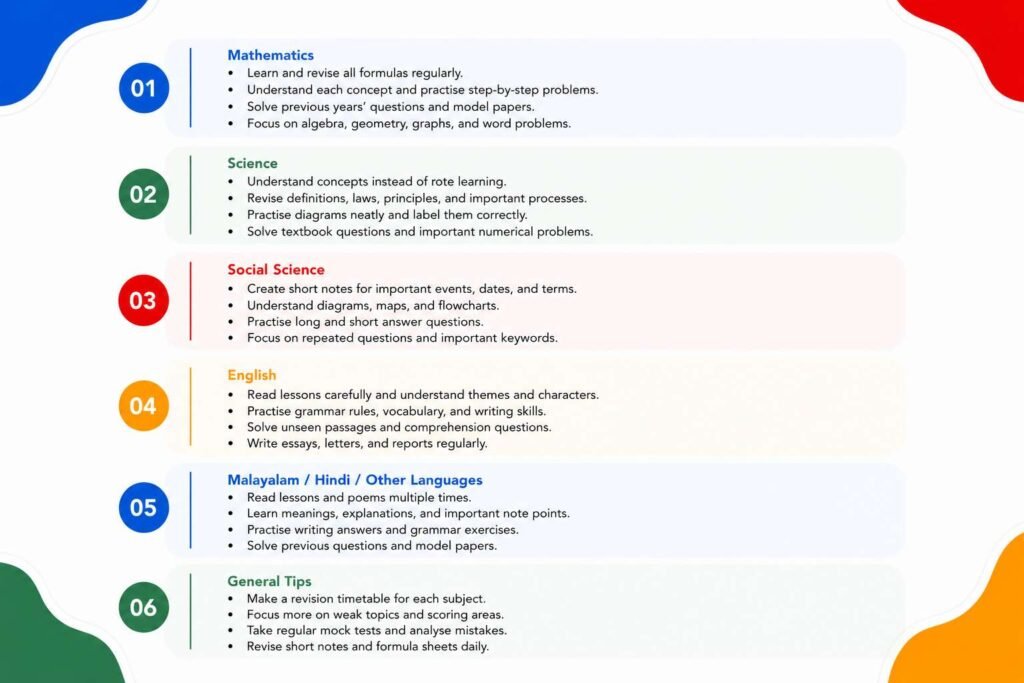
Different subjects require different preparation methods. Your Last 30 Days SSLC Exam Preparation Plan should therefore include subject-specific strategies.
Mathematics
Mathematics requires regular problem-solving rather than passive reading.
Focus on:
- Formulas
- Important concepts
- Step-by-step solutions
- Geometry
- Algebra
- Graph-related questions
- Repeated question patterns
- Previous examination problems
Maintain a formula sheet and revise it regularly.
When solving problems, write every important step clearly. Even when you know the answer, practising the complete solution improves speed and presentation.
Science
For Science, combine conceptual understanding with factual revision.
Revise:
- Definitions
- Processes
- Laws and principles
- Diagrams
- Experiments
- Important equations
- Applications
- Differences between related concepts
Practise drawing diagrams neatly and labelling them correctly.
Social Science
Social Science contains substantial theoretical content, so active recall is particularly useful.
Create short notes for:
- Important events
- Historical developments
- Geographical concepts
- Economic terms
- Civics concepts
- Important personalities and contributions
- Dates and sequences
Instead of repeatedly reading a chapter, close the book and try to explain the topic from memory.
Benefits of Following a 30-Day Study Plan
A structured plan offers several advantages.
Better Time Management
You know what to study each day instead of wasting time deciding what to do next.
Improved Revision
A planned schedule gives you enough opportunities to revisit important chapters.
Reduced Examination Stress
Knowing that the syllabus has been systematically covered can improve confidence.
Better Identification of Weak Areas
Regular tests and self-assessment reveal topics that require additional attention.
Improved Answer-Writing Skills
Repeated practice helps students write faster, clearer, and more complete answers.
Stronger Memory
Spaced revision is generally more useful for long-term recall than studying the same material intensely on one day.
Common Mistakes to Avoid in the Last 30 Days
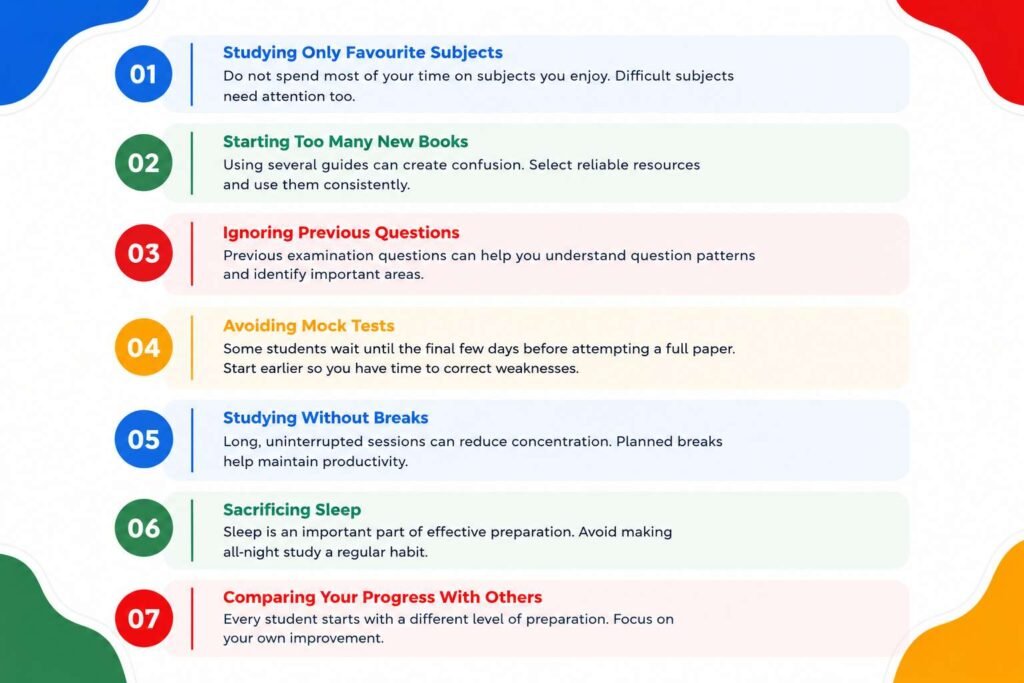
Even a good study plan can fail if students make avoidable mistakes.
Studying Only Favourite Subjects
Do not spend most of your time on subjects you enjoy. Difficult subjects need attention too.
Starting Too Many New Books
Using several guides can create confusion. Select reliable resources and use them consistently.
Ignoring Previous Questions
Previous examination questions can help you understand question patterns and identify important areas.
Avoiding Mock Tests
Some students wait until the final few days before attempting a full paper. Start earlier so you have time to correct weaknesses.
Studying Without Breaks
Long, uninterrupted sessions can reduce concentration. Planned breaks help maintain productivity.
Sacrificing Sleep
Sleep is an important part of effective preparation. Avoid making all-night study a regular habit.
Comparing Your Progress With Others
Every student starts with a different level of preparation. Focus on your own improvement.
How to Revise Faster and Remember More
Use active recall instead of simply rereading.
After studying a topic, close the book and ask yourself:
- What are the main points?
- Can I explain this concept?
- Can I write the definition?
- Can I solve a related problem?
- What questions could be asked from this topic?
Use flashcards, short notes, mind maps, tables, and question-and-answer practice when appropriate.
Another useful technique is spaced revision. Instead of revising a chapter only once, review it several times at increasing intervals.
For example:
Day 1: Learn
Day 3: Quick revision
Day 7: Practice questions
Day 14: Second revision
Final week: Rapid recall
How to Manage Screen Time During SSLC Preparation
Digital resources can be useful, but uncontrolled screen time can seriously reduce productivity.
Set specific periods for educational videos, online classes, or digital study material.
Avoid using your study device for unrelated activities during planned study sessions.
Useful habits include:
- Turning off unnecessary notifications
- Keeping social media away during study blocks
- Using headphones only when necessary
- Downloading required study materials beforehand
- Taking regular eye breaks
- Keeping devices away while solving written papers
The goal is not to avoid technology completely. It is to make technology serve your study plan.
How Parents Can Support SSLC Students
Parents can help students by creating a calm and consistent study environment.
They can encourage:
- A regular study schedule
- Adequate sleep
- Healthy meals
- Short breaks
- Practice tests
- Positive communication
Constantly asking about marks or comparing students with others may increase pressure. Encouragement and practical support are usually more helpful during the final month.
How to Stay Motivated During the Final Month
Motivation may change from day to day. Instead of depending entirely on motivation, create a routine.
Set small daily targets such as:
- Finish two chapters
- Solve 20 mathematics problems
- Complete one previous-question set
- Revise one difficult topic
- Take one timed test
At the end of the day, check what you completed.
Small achievements build momentum.
If a particular day does not go according to plan, do not abandon the entire schedule. Adjust the next day and continue.
A Simple Daily SSLC Study Routine
A balanced daily routine may look like this:
Session 1: Difficult subject and important concepts
Session 2: Second subject revision
Session 3: Practice questions
Session 4: Language or theory revision
Session 5: Mock test or problem-solving
Final session: Quick revision of the day’s learning
Keep the final session relatively light. Use it for formulas, definitions, keywords, and short notes rather than intensive new learning.
Final Week Checklist
Before entering the examination week, make sure you have:
- Revised every major chapter
- Practised previous questions
- Completed several model papers
- Reviewed mistakes
- Prepared formula and revision notes
- Practised important diagrams
- Revised writing formats
- Improved time management
- Organised stationery and examination materials
- Established a healthy sleep routine
Do not measure preparation only by the number of chapters completed. Your ability to recall, apply, and write what you have learned is equally important.
What to Do on the Day Before the Exam
The day before an examination should not become a marathon study session.
Focus on important revision points and avoid unnecessary panic.
Prepare your required materials in advance and check the examination instructions.
Get adequate sleep so that you can remain alert and focused during the paper.
Avoid comparing your preparation with classmates immediately before the examination. Last-minute discussions can sometimes create unnecessary confusion.
Conclusion
A successful Last 30 Days SSLC Exam Preparation Plan is based on smart revision rather than last-minute pressure. Divide the month into clear stages: complete weak areas, revise the syllabus, practise questions, take mock tests, analyse mistakes, and conduct final revision.
Do not aim for perfection every day. Aim for consistent progress. Use your time carefully, keep distractions under control, practise writing answers, and protect your sleep and concentration.For students preparing in Kerala, a focused routine during these final 30 days can help turn existing knowledge into stronger examination performance. You can refer to the official Kerala Pareeksha Bhavan website for SSLC examination updates, notifications, and other official information.